Use this path for Seleucid royal silver and bronze, Antioch mint attributions, Phoenician Alexander issues, and older references to Syrian kings. BMC Seleucid is the quickest English-language catalogue base. Babelon’s Rois de Syrie gives a larger French corpus for the royal coinages of Syria, Armenia, and Commagene and remains useful for Paris specimens, portraits, monograms, dates, and legacy citations.
Newell’s Antioch is the focused work for separating Antioch emissions and control marks from other Seleucid mints. Newell’s Tyre and Sidon-Ake studies are most useful when the coin belongs to the Phoenician coast or when hoard chronology, dated issues, and local mint sequence are the problem.
Distinguish the capital from other mint attributions
Eastern Seleucid Mints broadens the enquiry beyond Syria. Its opening treatment of Seleucia on the Tigris explains how excavated bronze coins helped anchor assignments that had previously depended on less definite provenance. Mørkholm’s Antiochia on the Persian Gulf is a separate eastern attribution and should not be conflated with the royal capital merely because of the shared name.
For a tightly bounded attribution problem, Noe on Alexandria Troas under Antiochus Hierax compares an Alexander-type tetradrachm with Seleucid issues through a civic symbol and monograms. For the end of royal rule at Antioch, Newell’s pre-imperial study separates a distinctive continuation of Philip Philadelphus types from the king’s regular coinage. These studies show why a ruler’s name alone does not settle either mint or date.
Use bronze denominations to test an attribution
Bellinger’s Timarchus study starts with a rare bronze denomination and compares the series with gold, silver, and earlier Seleucid issues. It is a useful small case study in the reasoning behind a proposed mint: distinguish the observed denomination and design from the argument placing its production at Ecbatana.
For a named Paris collection reference, Luynes III covers Asia Minor and Phoenicia, while Luynes IV includes Syria. These are collection catalogues, so a specimen reference in them serves a different purpose from a complete modern reconstruction of a mint’s output.
Recommended Works
- 1—The Bronze Coins of Timarchus, 162–0 B.C. Alfred R. Bellinger · 1945 · English · Research Article A newly acquired large bronze gives Bellinger a reason to reconsider the denominations and mint attribution of Timarchus's rare bronze coinage. He compares the bronze series with the...
- 2LuynesCatalogue of the Luynes Collection: Greek Coins, III. Asia Minor and Phoenicia Jean Babelon · 1930 · French · Collection Catalogue This volume describes the Luynes collection's Greek coins of Asia Minor and Phoenicia. It supplies a collection reference to compare with regional catalogues and later studies of... Luynes
- 3LuynesCatalogue of the Luynes Collection: Greek Coins, IV. Syria, Egypt, Cyrenaica, Mauretania, Zeugitana and Numidia Jean Babelon · 1936 · French · Collection Catalogue The fourth volume completes the geographical sequence of the Luynes collection catalogue with Syria, Egypt, Cyrenaica, and the listed regions of North Africa. It is useful for tracing... Luynes
- 4—The Coinage of the Eastern Seleucid Mints from Seleucus I to Antiochus III Edward T. Newell · 1938 · English · Specialized Corpus Newell organizes the eastern Seleucid coinages by mint and ruler, relating silver and bronze issues to symbols, find evidence, and historical geography. The opening treatment of Seleucia...
- 5—The Seleucid Mint at Antiochia on the Persian Gulf Otto Mørkholm · 1970 · English · Research Article Mørkholm republishes a sequence of Seleucid coins assigned to a mint near the head of the Persian Gulf, adding material and explaining the attribution more fully. The study covers issues...
- 6—Coinage at Alexandria Troas under Antiochus Hierax Sydney P. Noe · 1952 · English · Research Article Noe revisits an Alexander-type tetradrachm associated with Alexandria Troas under Antiochus Hierax. The feeding-horse symbol and shared monograms connect the piece with Seleucid-type...
- 7—The Pre-Imperial Coinage of Roman Antioch Edward T. Newell · 1919 · English · Research Article Newell isolates a series of tetradrachms carrying the name and types of Philip Philadelphus from the king's regular issues. Fabric, portrait style, monograms, and numerical marks provide...
- 8
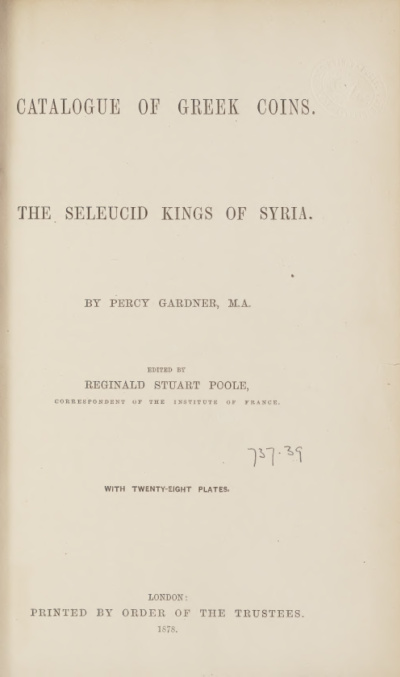 A Catalogue of the Greek Coins in the British Museum: The Seleucid Kings of Syria Percy Gardner · 1878 · English · Regional and Civic Catalogue This volume catalogues the British Museum’s holdings from Seleucid Syria and the Hellenistic East. It concentrates on Seleucid royal coinage arranged by ruler, mint, denomination... 10 plates BMC Seleucid
 - 9
 The Kings of Syria, Armenia and Commagene Ernest Babelon · 1890 · French · Specialized Corpus Babelon catalogues the royal coinages of Syria, Armenia, and Commagene in the Bibliothèque nationale, with twenty-eight plates and extensive historical commentary. The volume is valuable... 28 plates Babelon, Rois de Syrie
 - 10
 The Seleucid Mint of Antioch Edward T. Newell · 1918 · English · Specialized Corpus Newell’s foundational study reconstructs the output of the Seleucid mint at Antioch through ruler sequences, types, monograms, control marks, hoards, and die relationships, illustrated on... 13 plates Newell, Antioch
 - 11
 The First Seleucid Coinage of Tyre Edward T. Newell · 1921 · English · Specialized Corpus Newell isolates the earliest Seleucid issues of Tyre through types, monograms, fabric, hoard evidence, and die links, illustrated on eight plates. The work is useful for distinguishing... 8 plates Newell, Tyre
 - 12
 The Dated Alexander Coinage of Sidon and Ake Edward T. Newell · 1916 · English · Specialized Corpus Newell studies Alexander-type tetradrachms carrying dated or otherwise sequential marks at Sidon and Ake, using ten plates, die comparison, monograms, and local eras to build an absolute... 10 plates Newell, Sidon & Ake
 - 13
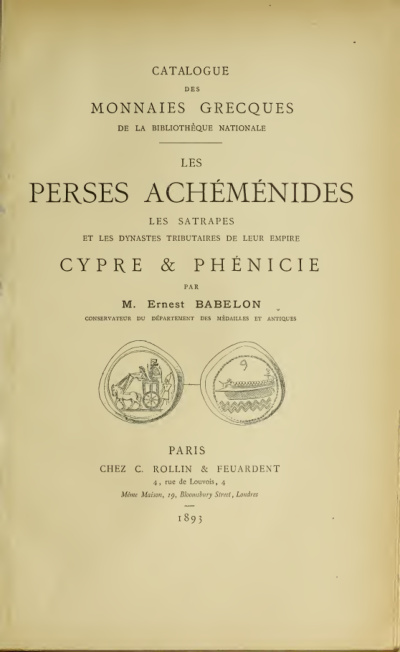 The Achaemenid Persians, the Satraps and the Tributary Dynasts Ernest Babelon · 1893 · French · Specialized Corpus Babelon catalogues Achaemenid royal coinage and the issues of satraps and dependent dynasts, drawing heavily on the Cabinet des Médailles and illustrating the material on thirty plates... 30 plates Babelon, Perses