Use this path when a coin is described as Macedonian, Alexander-type, Philip II, Demetrius Poliorcetes, or Paeonian, especially when the clue is an old BMC, AMNG, Newell, or Historia Numorum citation. Begin with BMC Macedonia for a broad English catalogue of British Museum specimens, then use AMNG III.1 for a more detailed German regional treatment of Macedonian and Paeonian royal, tribal, federal, civic, and provincial issues.
Newell’s Demetrius is the focused starting point for the coinage of Demetrius Poliorcetes and the mobile Hellenistic mint system after Alexander. Newell’s Sidon and Ake belongs here when an Alexander tetradrachm has Phoenician dates, monograms, or a question about mint chronology.
Test mint assignments against groups of coins
Newell’s Kyparissia introduction explains why he treated hoards as the foundation for revising Alexander coinage. His Demanhur study then shows the effect of an enlarged sample: additional specimens prompted corrections to earlier deductions and attributions. Both have links to their starting pages in the bound library scans.
Move from these broad hoard problems to a specific mint with Sinope or Sicyon. For the Peloponnese, compare the Megalopolis hoard with the Corinth find. Keep an attribution made from style or controls separate from an inference about circulation based on where a group was reportedly found.
Move from a hoard to a mint sequence
Troxell’s Macedonian studies provide a longer treatment of the Amphipolis silver sequence and Alexander’s lifetime gold. Use the separate treatments of denominations and die connections to frame a question before trying to assign an isolated coin to a calendar date.
May’s study of Nikokles at Paphos links a small inscription within the obverse design to a discussion of dies and the Demanhur material. It complements the older hoard publications above, while requiring care over the proposed provenance of the later-acquired group. For the Peloponnese, continue to the Sicyon reading path.
Recommended Works
- 1—Studies in the Macedonian Coinage of Alexander the Great Hyla A. Troxell · 1997 · English · Specialized Corpus Troxell studies the Macedonian silver and gold associated with Alexander the Great through catalogues, die connections, and hoard evidence. The first part examines the Amphipolis silver...
- 2—The Alexander Coinage of Nikokles of Paphos: With a Note on Some Recently Identified Tetradrachms from the Demanhur Find J. M. F. May · 1952 · English · Research Article May examines Alexander-type tetradrachms bearing the small name of Nikokles within the lion skin on the obverse. Die connections and a group of coins acquired from de Cosson support his...
- 3—Alexander Hoards I: Introduction and Kyparissia Hoard Edward T. Newell · 1921 · English · Specialized Corpus Newell introduces his program of studying Alexander coinage through hoards and applies it to the Kyparissia find. He explains why groups of associated coins can test dates, mint...
- 4—Alexander Hoards II: Demanhur, 1905 Edward T. Newell · 1923 · English · Specialized Corpus Newell returns to the large Demanhur hoard after examining additional material and revising earlier observations. He explains that the expanded sample permits corrections to mint...
- 5—The Alexandrine Coinage of Sinope Edward T. Newell · 1918 · English · Research Article Newell attributes a series of gold and silver coins of Alexander type to Sinope, placing the argument in the city's Black Sea commercial setting. The study compares that proposed mint...
- 6—Alexander Coinage of Sicyon Sydney P. Noe · 1950 · English · Specialized Corpus Noe develops a study of Alexander-type coinage assigned to Sicyon using the extensive material and organized research inherited from Edward T. Newell. The introduction explains how...
- 7—The Alexander Hoard of Megalopolis David M. Robinson · 1950 · English · Research Article Robinson publishes forty silver coins said to have been found near Megalopolis, explaining the dealer-mediated report and its limitations. The study places the material beside earlier...
- 8
 A Catalogue of the Greek Coins in the British Museum: Macedonia, etc. Barclay V. Head · 1879 · English · Regional and Civic Catalogue This volume catalogues the British Museum’s holdings from Macedonia and Paeonia. It concentrates on Macedonian royal, tribal, federal, and civic coinages, including the Argeads, Philip... BMC Macedonia
 - 9
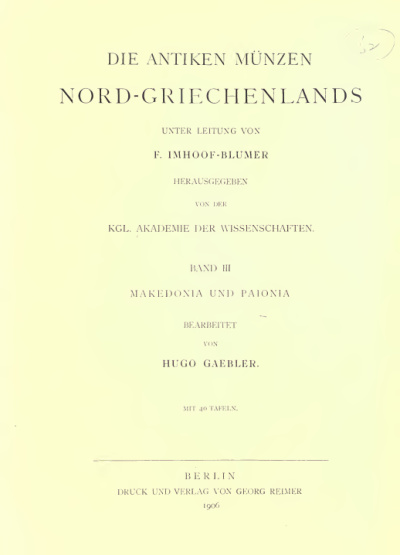 Ancient Coins of Northern Greece, Vol. III.1: Makedonia and Paionia Hugo Gaebler · 1906 · German · Regional and Civic Catalogue Gaebler’s volume is a systematic catalogue of Macedonian and Paeonian coinage, treating royal, tribal, federal, and civic issues with detailed legends, types, denominations, and specimen... 5 plates
 - 10
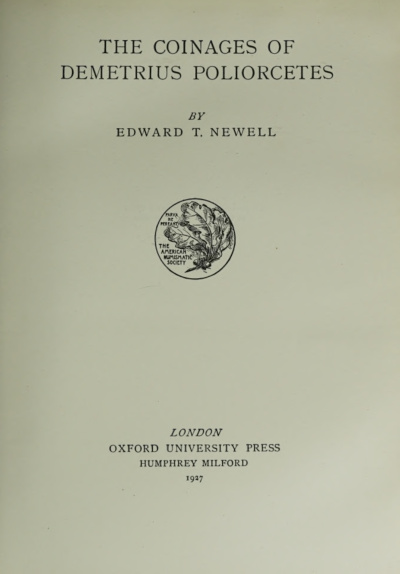 The Coinages of Demetrius Poliorcetes Edward T. Newell · 1927 · English · Specialized Corpus Newell reconstructs the coinages of Demetrius Poliorcetes by combining portraits, types, monograms, hoards, and die links across a mobile network of royal mints. The eighteen plates and... 18 plates Newell, Demetrius
 - 11
 The Dated Alexander Coinage of Sidon and Ake Edward T. Newell · 1916 · English · Specialized Corpus Newell studies Alexander-type tetradrachms carrying dated or otherwise sequential marks at Sidon and Ake, using ten plates, die comparison, monograms, and local eras to build an absolute... 10 plates Newell, Sidon & Ake
 - 12—Primitive Hellenism in Macedonia Proved by Numismatics and Language Ioannis N. Svoronos · 1919 · French · Handbook / Manual Svoronos uses Macedonian coins, names, symbols, and linguistic evidence to argue for the early Hellenic character of Macedonia. The work is useful for the historiography of Macedonian...
- 13
 Historia Numorum: A Manual of Greek Numismatics Barclay V. Head · 1887 · English · Handbook / Manual The first edition of Historia Numorum provides a mint-by-mint survey of Greek coinage, summarizing chronology, metals, standards, types, legends, rulers, and historical context across the... HN¹