A Helios head or rose directs a search toward Rhodian types, but the design alone does not establish that a coin was struck on Rhodes. This path separates the classification of an island’s own issues from the attribution of related designs elsewhere.
Begin with a defined series
Ashton’s Rhodian bronze study groups three series and argues for a connection with the aftermath of the earthquake of 229–226 BC. The proposed historical setting depends on a catalogue of specimens, dies, and controls. Record the group and the distinguishing details before applying that interpretation to an individual coin.
Compare types with attribution evidence
In the study of pseudo-Rhodian drachms and the Lycian League, Ashton argues that two series were struck on the mainland and examines countermarks connecting the discussion with Lycia. The distinction matters: a Rhodian design, a proposed mint, and the place where a countermark was applied are separate claims. The article provides a compact example of how those claims are tested with different evidence.
Use the BMC volumes for Caria and Lycia to resolve older specimen references. When a later paper changes an assignment, retain the earlier reference alongside the newer attribution so the same recorded specimen remains traceable.
Separate the island’s silver series
Compare the mid-third-century didrachms with the late plinthophoric hemidrachms and the post-plinthophoric drachms. Denomination, the treatment of the rose, and the arrangement of names and symbols determine which study to consult. A broad search for “Rhodian silver” is only a first step.
Follow a mainland attribution through revisions
For Caria, begin with the Mylasa corpus and compare the solar-disk drachms, whose proposed historical setting does not settle their precise mint. For central Greece, read the 1995 study before the 1997 additions. The sequence shows how new specimens can strengthen or revise a connection.
The argument for Kos offers a compact example of an attribution supported by die links and the ethnic. When recording a conclusion, keep the visible evidence—letters, symbol, die connection—alongside the author’s interpretation. These newer studies are source-linked references; their pages identify the public repository to consult for access.
Recommended Works
- 1—A Series of Rhodian Didrachms from the Mid-Third Century BC R. H. J. Ashton · 1989 · English · Research Article Ashton studies a defined series of Rhodian didrachms with a radiate head of Helios and a rose, distinguishing issues by their letters and accompanying symbols. A specimen and die...
- 2—The Solar Disk Drachms of Caria R. H. J. Ashton · 1990 · English · Research Article Ashton re-examines a group of drachms that had been assigned to several different places, bringing the surviving specimens into a die study. He proposes a Carian setting under the...
- 3—A Hoard of Late Rhodian Plinthophoric Hemidrachms (CH 4, 72) R. H. J. Ashton · 1991 · English · Research Article This short study revisits a parcel of Rhodian silver recorded in Coin Hoards and separates its worn, late plinthophoric hemidrachms from earlier coins of less certain association. Ashton...
- 4—The Pseudo-Rhodian Drachms of Mylasa R. H. J. Ashton · 1992 · English · Research Article Ashton revises the study of a major group of pseudo-Rhodian drachms, correcting readings and die links in earlier work and arguing for Mylasa rather than Kaunos. The catalogue and die...
- 5—Pseudo-Rhodian Drachms from Central Greece R. H. J. Ashton · 1995 · English · Research Article Ashton brings together six related issues of pseudo-Rhodian drachms and examines their connections and proposed origins in central Greece. Types, inscriptions, controls, and die...
- 6—More Pseudo-Rhodian Drachms from Mainland Greece R. H. J. Ashton · 1997 · English · Research Article This supplement adds specimens and die connections to Ashton's earlier treatment of pseudo-Rhodian drachms from central Greece. New evidence strengthens the discussion of Haliartos and...
- 7—The Post-Plinthophoric Silver Drachms of Rhodes R. H. J. Ashton and A.-P. C. Weiss · 1997 · English · Research Article Ashton and Weiss re-examine the Rhodian drachms with a radiate head of Helios and a full-blown rose viewed from above. Newly recorded material and two hoards enlarge the evidence for...
- 8—The Pseudo-Rhodian Drachms of Kos R. H. J. Ashton · 1998 · English · Research Article Ashton argues that four pseudo-Rhodian issues belong to Kos in the late 170s BC. His case combines shared obverse dies with inscriptions and symbols, including an issue on which the...
- 9—Rhodian Bronze Coinage and the Earthquake of 229–226 BC R. H. J. Ashton · 1986 · English · Research Article Ashton groups three Rhodian bronze series and argues that they belong together in the aftermath of the late-third-century earthquake. His catalogue records specimens and die combinations...
- 10—Pseudo-Rhodian Drachms and the Beginning of the Lycian League Coinage R. H. J. Ashton · 1987 · English · Research Article Ashton argues for a mainland origin of two Rhodian-type drachm series and considers their relationship with early Lycian League coinage. Countermarks, dies, types, and controls support...
- 11
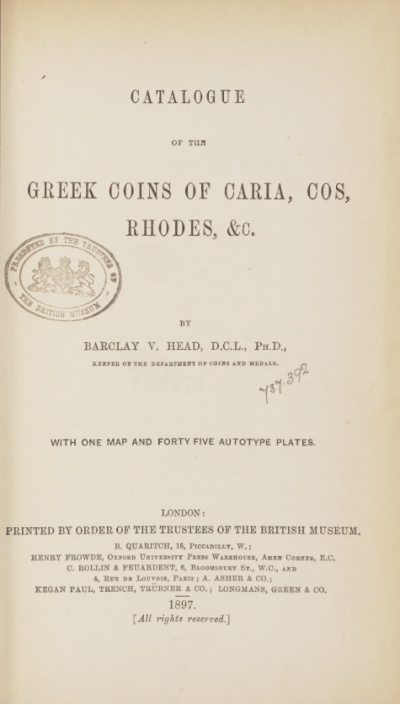 A Catalogue of the Greek Coins in the British Museum: Caria, Cos, Rhodes, etc. Barclay V. Head · 1897 · English · Regional and Civic Catalogue This volume catalogues the British Museum’s holdings from Caria, Cos, Rhodes, and islands off Caria. It concentrates on Carian dynastic and civic issues, Rhodian plinthophoroi, Coan... 38 plates BMC Caria
 - 12
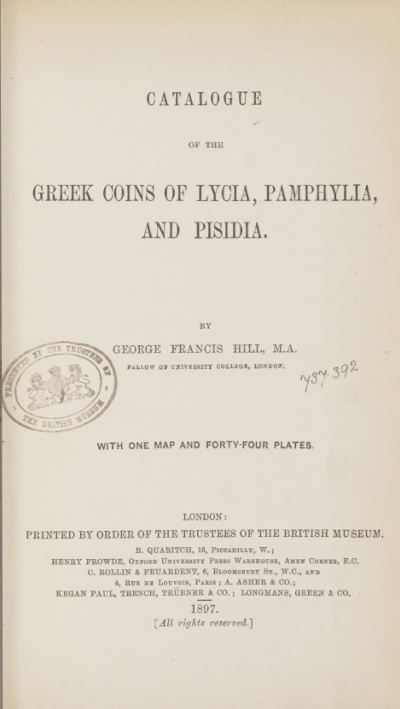 A Catalogue of the Greek Coins in the British Museum: Lycia, Pamphylia, and Pisidia George Francis Hill · 1897 · English · Regional and Civic Catalogue This volume catalogues the British Museum’s holdings from Lycia, Pamphylia, and Pisidia. It concentrates on Lycian dynastic, Pamphylian, Pisidian, and Roman provincial coinages; useful... 39 plates BMC Lycia
 - 13—The Coinage of Lycia, to the Time of Alexander the Great George F. Hill · 1895 · English · Research Article Hill revisits the arrangement of early Lycian coinage established by Six and Babelon, adding newly available varieties and reconsidering the sequence. He distinguishes numismatic evidence...